
Zhixian Li, Ph.D.李致贤
 WeChat
Official Account
SCI papers
Granted CN & US invention patents
First-Class Course: Principles of Chemical Engineering
Graduate students supervised or co-supervised
Ph.D. in Chemical Engineering from Tsinghua University (2016). His research focuses on the modification and high-value utilization of lignin, with a series of advances in mild, efficient catalytic depolymerization and conversion of lignin. He has led multiple projects, including grants from the National Natural Science Foundation of China and a sub-project of the National Key R&D Program, published 60+ SCI papers in journals such as ACS Catalysis (30 as first or corresponding author), and holds 11 granted Chinese and US invention patents. He also serves on the Youth Editorial Board of Lignin Research.
Research
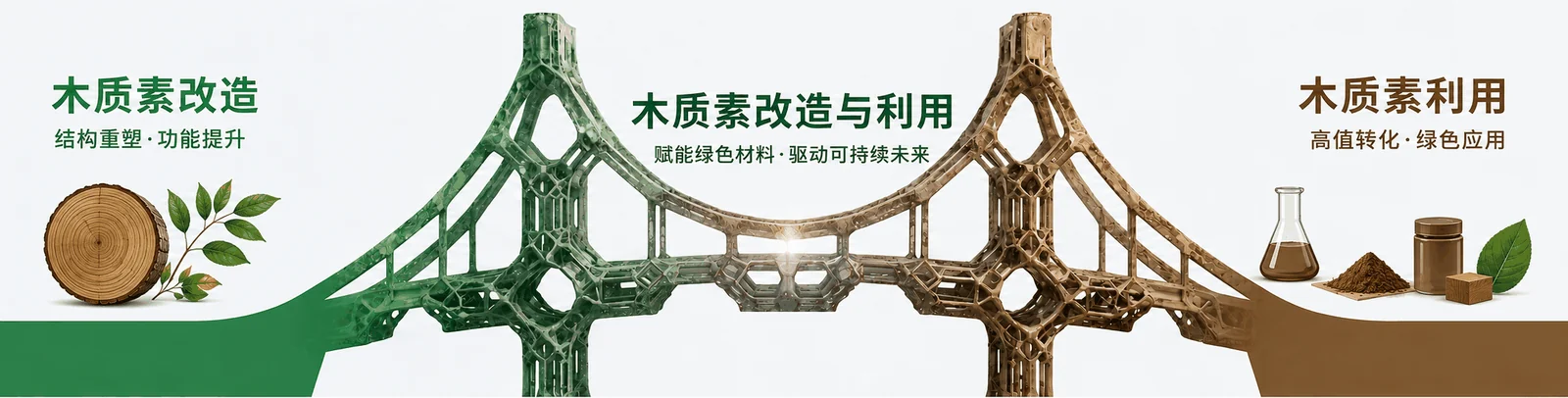
With high-value utilization of lignin as the main line, the work links "depolymerization — modification — materials" into one whole: guided by the target functional material, lignin is depolymerized and modified in a controlled way and then built into high-value functional materials.
01Lignin Depolymerization and Modification
COFs and single-atom nanozymes mimicking laccase and peroxidase selectively depolymerize lignin under mild conditions into aromatic monomers and platform chemicals, complemented by grafting, sulfonation and amination.
02Lignin-Based Functional Materials
Using modified lignin as a platform molecule for energy, environment, biomedicine and green chemical engineering: resins and adhesives, antibacterial materials, photothermal materials (interfacial evaporation, photothermal sterilization) and carbon materials.
Selected PublicationsAll 30
- High-Efficiency Dual-Site Biomimetic Catalyst for Lignin Depolymerization. ACS Catalysis, 2025, 15(3): 2595-2606. (co-corresponding)
- Boosting Catalytic Performance of Cytochrome c through Tailored Carboxymethylation in Covalent Organic Frameworks. ACS Catalysis, 2024, 14(10): 7639-7648. (co-corresponding)
- Engineering the Enzyme–Support Interface: Arginine-Directed Anchoring of Peroxygenase on a β-Ketoester Covalent Organic Framework. ACS Appl. Mater. Interfaces, 2026, 18(37): 51464-51474. (co-corresponding)
- Biomimetic Dual-Coordination-Sphere Porphyrin-Based Covalent Organic Frameworks Enable Efficient and Selective Furfural Oxidation. ACS Appl. Mater. Interfaces, 2025, 17(36): 51043-51052. (corresponding)
- Chlorine Axial Coordination Enables Peroxidase Mimicking and Lignin Depolymerization in Fe-N3O Single-Atom Nanozymes. ACS Appl. Mater. Interfaces, 2025, 17(30): 43378-43389. (corresponding)
Teaching
Teaches Principles of Chemical Engineering in both Chinese and English-medium classes. The teaching reform advances in three steps; 3D printing and AI serve only as tools, while hands-on work and judgment stay with the students:
Teaching research published in Chemical Higher Education (2024, 2026; one more accepted). Self-built simulation platforms (in Chinese):